· 5.7 understand that a substance can change state from solid to liquid by the process of melting
· 5.8 understand that a substance can change state from liquid to gas by the process of evaporation or boiling
· Questions from Collins p.112
· Answer in Bullet Points!
[cid:image002.png@01CC9575.87F11DE0]
[cid:image003.png@01CC9575.87F11DE0]
· Use following pages from Collins as a resource to help you
[cid:image019.jpg@01CC9576.07199B60]
[cid:image020.jpg@01CC9576.07199B60]
[cid:image021.jpg@01CC9576.07199B60]
[cid:image022.jpg@01CC9576.07199B60]
[cid:image023.jpg@01CC9576.07199B60]
Revised version
1) Use ideas about particles to explain why:
a) Solids keep their shape, but liquids and gases don’t
Particles in solid have tight bonds within one another. They are held in a fixed, regular pattern and cannot move; they only vibrate in position. On the other hand, the bonds between particles in liquids and gases are much weaker. b) Solids and liquids have a fixed volume, but gases fill their container Solids have strong bonds within the particles. Their arrangement is very tight; they are incompressible. However, there are lots of spaces between liquids and gases (especially gases). The intermolecular forces are weak so they can spread out to fill their container. 3) Using ideas about particles, explain the difference between evaporating and boiling.
Evaporating and boiling both require energy to overcome bonds to turn into gas. Evaporation takes place on the surface of the liquid while boiling takes place in the entire volume of the liquid. Evaporation occurs for a range of temperatures; high temperatures increase evaporation and low temperatures decrease evaporation. Boiling takes place at a fixed temperature called the boiling point. 5.7 and 5.8 Experiment - Cooling Curve of Stearic Acid using datalogger 15 October 2010 14:34
[cid:image024.jpg@01CC9576.07199B60]
5.7 to 5.10 Plenary 1 28 October 2011 12:19 · Play the Stage 1 game to test your knowledge of solids, liquids and gases
· Play the Stage 2 game to test your knowledge about changes of phase! 5.7 to 5.10 Plenary 2 28 October 2011 12:19
Play the Level 1 game to test your knowledge of the properties of solids, liquids and gases Extension: Play the Level 2 game to extend your knowledge about changes of phase! PhET States of matter simulation - embedding into your Posterous blog 28 October 2011 11:14
· Create a post
[cid:image016.png@01CC9575.87F11DE0]
· Turn on HTML editor
[cid:image017.png@01CC9575.87F11DE0]
· Copy in this text and Publish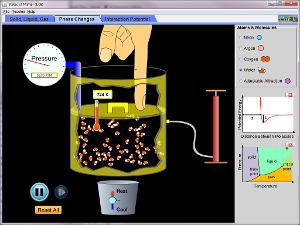
· Success! Now have a play with the simulation...
[cid:image018.png@01CC9575.87F11DE0] 


· 5.8 understand that a substance can change state from liquid to gas by the process of evaporation or boiling
· Questions from Collins p.112
· Answer in Bullet Points!
[cid:image002.png@01CC9575.87F11DE0]
[cid:image003.png@01CC9575.87F11DE0]
· Use following pages from Collins as a resource to help you
[cid:image019.jpg@01CC9576.07199B60]
[cid:image020.jpg@01CC9576.07199B60]
[cid:image021.jpg@01CC9576.07199B60]
[cid:image022.jpg@01CC9576.07199B60]
[cid:image023.jpg@01CC9576.07199B60]
Revised version
1) Use ideas about particles to explain why:
a) Solids keep their shape, but liquids and gases don’t
Particles in solid have tight bonds within one another. They are held in a fixed, regular pattern and cannot move; they only vibrate in position. On the other hand, the bonds between particles in liquids and gases are much weaker. b) Solids and liquids have a fixed volume, but gases fill their container Solids have strong bonds within the particles. Their arrangement is very tight; they are incompressible. However, there are lots of spaces between liquids and gases (especially gases). The intermolecular forces are weak so they can spread out to fill their container. 3) Using ideas about particles, explain the difference between evaporating and boiling.
Evaporating and boiling both require energy to overcome bonds to turn into gas. Evaporation takes place on the surface of the liquid while boiling takes place in the entire volume of the liquid. Evaporation occurs for a range of temperatures; high temperatures increase evaporation and low temperatures decrease evaporation. Boiling takes place at a fixed temperature called the boiling point. 5.7 and 5.8 Experiment - Cooling Curve of Stearic Acid using datalogger 15 October 2010 14:34
[cid:image024.jpg@01CC9576.07199B60]
5.7 to 5.10 Plenary 1 28 October 2011 12:19 · Play the Stage 1 game to test your knowledge of solids, liquids and gases
· Play the Stage 2 game to test your knowledge about changes of phase! 5.7 to 5.10 Plenary 2 28 October 2011 12:19
Play the Level 1 game to test your knowledge of the properties of solids, liquids and gases Extension: Play the Level 2 game to extend your knowledge about changes of phase! PhET States of matter simulation - embedding into your Posterous blog 28 October 2011 11:14
· Create a post
[cid:image016.png@01CC9575.87F11DE0]
· Turn on HTML editor
[cid:image017.png@01CC9575.87F11DE0]
· Copy in this text and Publish
| Click to Run |
· Success! Now have a play with the simulation...
[cid:image018.png@01CC9575.87F11DE0]


No comments:
Post a Comment