Tuesday, 27 March 2012

1.23

1.23 starter

14 March 2012

16:23
· Why does kicking a brick hurt your foot?
· Why does kicking a football not hurt your foot?
>

1.23

Tuesday, July 06, 2010

3:04 PM
· 1.23 use the relationship between force, change in momentum and time taken:

force = change in momentum

time taken

F = Δp / t

From N2L F = m x a

but a = v - u / t

so F = m (v - u) / t

F = mv - mu / t

but p = mv

so F = pf - pi / t

F = Δp / t

can be written as Δp = F x t = Impulse

We can express the green equation in words as...

"Force is the rate of change of momentum"

How to catch a high velocity egg!

Example 1

Why would you prefer to fall onto a bed than onto concrete? (3 marks)

Answer
· Concrete or soft bed, your change in momentum is equal
· With a soft bed, this change in momentum takes place over a longer time
· This means that the force needed to change your momentum is less

or use the equation
· Impulse = Δp = F x t where Δp = constant
· soft bed => increases t
· and therefore decreases F

Example 2 - Pearson, p.41

[cid:image001.jpg@01CD0CE6.B2259030]

Answer

F = Δp / t

10,000 = Δp / 60

Δp = 600,000kgm/s

Δp = mv - mu

Δp = m(v - u)

600,000 = 1,200(v - 2000)

v - 2000 = 500

v = 2500m/s

1.23 Plenary questions

13 March 2012

15:20

Physics for You p.147 Q1d-f, Q2b

1

[cid:image002.png@01CD0CE6.B2259030]

2b. When you jump down from a table, why do you bend your legs rather than keep them rigid? (3 marks)

Impulse - kicking a ball and kicking a brick.swf Download this file

Wednesday, 21 March 2012

Homework for next week, pt.1

Image001

· Complete in your exercise book

· Draw initial and final diagrams! Formula, substitution, answer and units!

1.20 to 1.24 Plenary extension question

13 March 2012

15:20

Physics for You p.147 Q6

[cid:image001.png@01CD0770.6226E460]

1.22 Plenary answers

1.22

1.22

Tuesday, July 06, 2010

3:04 PM
· 1.22 use the conservation of momentum to calculate the mass, velocity or momentum of objects

Momentum conserved in collisions
· http://www.youtube.com/watch?v=b6QzJSUKzQM
· and http://www.walter-fendt.de/ph14e/collision.htm


>

>


Momentum conserved in explosions


>

Example - Pearson, p.41

[cid:image001.jpg@01CD076A.F1E42140]

Consider final momentum

Truck, plasticine and pellet

p = m x v

p = (0.1+0.002) x 0.8

p = 0.0816kgm/s

total final momentum = pf = 0.0816kgm/s

Principle of Conservation of Momentum tells us:

total initial momentum = total final momentum

Σpi = Σpf

so total initial momentum = pi = 0.0816kgm/s

Consider initial momentum

Truck and plasticine

p = m x v

p = 0.1 x 0

p = 0kgm/s

Pellet

p = m x v

0.0816 = 0.002 x v

v = 40.8m/s

1.22 animation

14 March 2012

15:49

Website:

http://www.walter-fendt.de/ph14e/collision.htm

Embed code for your blog:

Example:

http://maddog11physics.posterous.com/conservation-of-momentum-animation#

1.22 Plenary questions

13 March 2012

15:20

Physics for You p.147 Q1g+h, 3+4

1

[cid:image002.jpg@01CD076A.F1E42140]

[cid:image003.jpg@01CD076A.F1E42140]

[cid:image004.jpg@01CD076A.F1E42140]

newtons_cradle[1].swf Download this file

AirTrack simulation.swf Download this file

1.20

Image001

1.20

Tuesday, July 06, 2010

3:04 PM
· 1.20 know and use the relationship between momentum, mass and velocity:

momentum = mass × velocity

p = m × v

p = m × v

p = momentum (kgm/s)

m = mass (kg)

v = velocity (m/s)

1.20 Plenary questions

13 March 2012

15:20

Physics for You p.147 Q1a-c

[cid:image001.png@01CD0767.C8D39DB0]

Wednesday, 14 March 2012

7.17 and 7.18

7.17 and 7.18 starter

13 January 2012

14:02

A fuel that doesn’t burn. What is it?

Answers
· Uranium. When Uranium atoms split into two (fission) they release energy which can be captured in a nuclear power station. This is a nuclear reaction and is fundamentally different to burning (combustion is a chemical reaction)

7.17 and 7.18 starter 2

13 January 2012

14:02

How many protons and neutrons are there in
· 23592U?
· 23692U?

Answers
· 23592U = 92 protons; 143 neutrons.

This radioisotope of Uranium is commonly used as a fuel for nuclear power stations
· 23692U = 92 protons; 144 neutrons

This radioisotope of Uranium is highly unstable and is artificially created in nuclear power stations where it undergoes fission

7.17 and 7.18

12 January 2012

10:32
· 7.17 understand that a nucleus of U-235 can be split (the process of fission) by collision with a neutron, and that this process releases energy in the form of kinetic energy of the fission products
· 7.18 recall that the fission of U-235 produces two daughter nuclei and a small number of neutrons
>
>

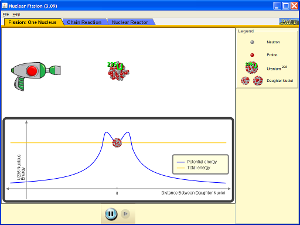
PhET animation - nuclear fission

31 January 2012

13:34
>

Website

http://phet.colorado.edu/en/simulation/nuclear-fission

Embed code for your blog

Nuclear Fission

Click to Run

U235 fission animation.swf Download this file

Nuclear Fission.pptm Download this file

7.15 and 7.16 Plenary Answers

Thank you

SooHyun

SooHyun Lee
11P
Bangkok Patana School
________________________________________
From: Matt Baker
Sent: 14 March 2012 13:25
To: Andrew Koomenjoe Nyaga; Arisara Amrapala; Boondaree Chang; Chrischawit Chomsoonthorn; Christopher Lo; Connor Blair Sailes; Frazer Allen Briggs; Huei-Yu Daniel Lo; Isabel Catriona McDonald; Kavin Supatravanij; Luke Michael Gebbie; Lydia Anna Foley; Morrakot Sae-Huang; Puchawin Borirackujarean; Qing Tang; Sanyam Grewal; Sebastien Grimm; Soo Hyun Lee; Tatiksha Singh; Usa Wongsanguan; Yanida Areekul; Yi-Lin Huang
Subject: 7.15 and 7.16 Plenary Answers

7.15 and 7.16 Plenary Answers

12 January 2012

10:24
1. How are alpha particles deflected by the "Plum Pudding Model"

[cid:image001.jpg@01CD01E5.DFD5ED10]

The alpha particles are not deflected - they pass straight through


2. How are alpha particles deflected by "Rutherford's Nuclear Model"

[cid:image002.jpg@01CD01E5.DFD5ED10]
· Most alpha particles are undeflected and pass straight through
· Some alpha particles are deflected through a small angle
· A few alpha particles are deflected through a large angle


· What happens if you increase the speed of the alpha particles?

[cid:image003.jpg@01CD01E5.DFD5ED10]

The amount of deflection decreases as the alpha particles have more Kinetic Energy to overcome a greater amount of Electrostatic Potential Energy of their repulsion with the nucleus.


4. What happens if you increase the charge of the nucleus?

[cid:image004.jpg@01CD01E5.DFD5ED10]

The amount of deflection increases as there is now greater electrostatic repulsion between the nucleus and the alpha particle


5. What happens if you increase the number of neutrons in the nucleus?

[cid:image005.jpg@01CD01E5.DFD5ED10]

The amount of deflection is unaffected (increasing the number of neutrons does not affect the charge on the nucleus)

7.15 and 7.16 Plenary

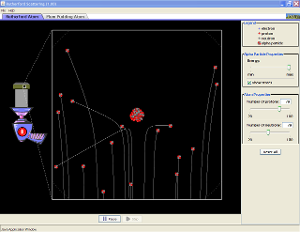
PhET animation - alpha particle scattering

31 January 2012

13:34
>

Website

http://phet.colorado.edu/en/simulation/rutherford-scattering

Embed code for your blog

Rutherford Scattering

Click to Run

7.15 and 7.16 Plenary

12 January 2012

10:24
>

Use "PhET animation - alpha particle scattering" to answer the following


1. [cid:image001.gif@01CD01E4.01C2D750] How are alpha particles deflected by the "Plum Pudding Model"
[cid:image002.gif@01CD01E4.01C2D750]

[cid:image003.jpg@01CD01E4.01C2D750]

2. How are alpha particles deflected by "Rutherford's Nuclear Model"

[cid:image004.jpg@01CD01E4.01C2D750]


3. What happens if you increase the speed of the alpha particles? Why?

[cid:image005.jpg@01CD01E4.01C2D750]


4. What happens if you increase the charge of the nucleus? Why?

[cid:image006.jpg@01CD01E4.01C2D750]


5. What happens if you increase the number of neutrons in the nucleus? Why?

[cid:image007.jpg@01CD01E4.01C2D750]

Wednesday, 7 March 2012

7.14

7.15 and 7.16

7.15 and 7.16 starter

12 January 2012

10:36
· What is the charge on an alpha particle?
· What is the charge on the nucleus of a gold atom, 19779Au?
· If an alpha particle came close to the nucleus of a gold atom, what would happen?

Answers
· Alpha particle, charge = +2
· Nucleus of gold atom, charge = +79
· The positive charge on the alpha particle will repel with the positive charge on the gold nucleus and the alpha particle would be deflected. Have a look at the animation to see this happening

>

7.15 and 7.16

12 January 2012

10:24
· 7.15 describe the results of Geiger and Marsden’s experiments with gold foil and alpha particles
· 7.16 describe Rutherford’s nuclear model of the atom and how it accounts for the results of Geiger and Marsden’s experiment and understand the factors (charge and speed) which affect the deflection of alpha particles by a nucleus

Alpha particle scattering experiment and the nuclear atom - taken from BBC "The Atom"

Rutherford's Experiment: Nuclear Atom


>


>
>

DJFPh105rutherford.swf Download this file

alpha particle scattering.pptx Download this file

alpha particle scattering - atomic structure evidence.swf Download this file

7.14

7.14 starter

01 February 2012

13:08

Tell the person next to you…
· What is the most dangerous type of radiation outside the body? Why?
· What is the most dangerous type of radiation inside the body? Why?
>
>

Answers
· Gamma radiation is the most dangerous type of radiation outside the body because it is extremely penetrating. (Alpha radiation is not dangerous because it is stopped by skin)
· Alpha radiation is the most dangerous type of radiation inside the body because it is highly ionising due to its high charge (+2) and high mass (RAM=4). (Gamma radiation is only very weakly ionising)

7.14

12 January 2012

10:24
· 7.14 describe the dangers of ionising radiations, including:
· radiation can cause mutations in living organisms
· radiation can damage cells and tissue
· the problems arising in the disposal of radioactive waste
>

Chernobyl Disaster

Hiroshima and Nagasaki - the first nuclear bombs

After the Hiroshima bomb

Dangers of radioactivity.pptm Download this file

alpha, beta, gamma - effect on human body.pptx Download this file

7.13

7.13

12 January 2012

10:24
· 7.13 describe the uses of radioactivity in medical and non-medical tracers, in radiotherapy and in the radioactive dating of archaeological specimens and rocks
>

Medical Tracers

Radioactive Dating
>
>

Thickness control mill
>

Uses of radioactivity.pptm Download this file

thickness of metal using beta radiation.swf Download this file

DJFPh108dating5.swf Download this file

DJFPh106carb2.swf Download this file

7.4 to 7.12 Plenary questions

radioactivitty plenary multichoice questions.pptm Download this file

7.4 to 7.12 Plenary questions

01 February 2012

10:35

>

7.10 to 7.12 answers

7.10 to 7.12 answers

01 February 2012

09:46
1. What happens to the amount of ‘mother’ nuclei as time passes?

Decrease
2. What sort of radioisotope will decay the fastest - one with a long half life or one with a short half life?

One with a short half life
3. Does half life tell us exactly when a particular nucleus in a radioisotope will decay?

No. It is a random process - we can not know exactly when a particular nucleus will decay
4. What are the two definitions of half life?
a. The time taken for the activity of a sample to halve
b. The time taken for the number of radioactive atoms in a sample to halve
5. What does the activity of a source mean?

The number of decays per second
6. What is the unit of activity?

Becquerel (Bq)
7. What will happen to the number of ‘mother’ nuclei after two half lives?

1 ==> ½ ==> ¼

1xhalf life 2xhalf life

The number of mother nuclei will be ¼ of the original number
8. What will happen to the activity of a source after two half lives?

1 ==> ½ ==> ¼

1xhalf life 2xhalf life

The activity will be ¼ of the original activity

7.10 to 7.12 calculation answers

12 January 2012

10:24
1. A radioisotope has a half life of 12 years. What fraction of the radioisotope will be left after 60 years?

Fraction remaining:

1 ==> ½ ==> ¼ ==> 1/8 ==> 1/16 ==> 1/32

1xhalf life 2xhalf life 3xhalf life 4xhalf life 5xhalf life

12 years 24 years 36 years 48 years 60 years


2. If the activity of a sample falls to 1/64th of its original level after 2 hours, what is the half life of the sample?

1 ==> ½ ==> ¼ ==> 1/8 ==> 1/16 ==> 1/32 ==> 1/64

1xhalf life 2xhalf life 3xhalf life 4xhalf life 5xhalf life 6xhalf life

Decay takes 2 hours (= 120 minutes)

This is 6 half lives

So 1 half life = 120 minutes / 6 half lives = 20 minutes


3. The background radiation in a laboratory is 7 Bq. The count rate from a radioisotope is measured and it has a reading of 119 Bq. If the half life of the radioisotope is 10 minutes, what will be the reading 20 minutes later?

Initial count rate at detector = 119 Bq

But Background rate = 7 Bq

So activity of radioisotope = 119 – 7 = 112 Bq

1 ==> ½ ==> ¼

1xhalf life 2xhalf life

10mins + 10mins = 20mins

112Bq ==> 56Bq ==> 28Bq = activity of radioisotope after 20 mins

But this doesn’t include the background rate!

Detector reading = 28Bq + 7Bq = 35Bq


4. Potassium decays into argon. The half life of potassium is 1.3 billion years. A sample of rock from Mars is found to contain three argon atoms for every atom of potassium. How old is the rock?

Proportion of K: 1 ==> ½ ==> ¼

Proportion of Ar: 0 ==> ½ ==> 3/4

1xhalf life 2xhalf life

So after 2 half lives there will be 3 times as many Ar atoms as K atoms

Age of rocks = 2 x half life = 2 x 1.3x109 = 2.6 billion years