Improvement Plan - A4.doc Download this file
5.19 Experiment
07 November 2011
14:32
| |||
| |||
|
· Change the pressure of a fixed mass of gas at a constant temperature
· Measure the volume
· Use the EXCEL spreadsheet to analyse your results
5.19 Blank EXCEL spreadsheet for Boyle's Law practical
07 November 2011
16:16
<<Ideal Gas - Boyle's Law.xlsx>>

Cloud formation
· Place a little water in the bottom of a 1½ litre plastic bottle
· Squeeze a few times
· Introduce a small amount of smoke
· Squeeze and release several times
· When you squeeze, the cloud disappears; when you release, the cloud reforms
Explanation
· When the pressure increases the temperature increases and vica versa
· The smoke particles are nucleating sites on which the water can condense
5.18 use the relationship between the pressure and Kelvin temperature of a fixed mass of gas at constant volume:
p1 / T1 = p2 / T2
p1 = Pressure at the beginning [kPa, bar or atm ]
T1 = Absolute temperature at the beginning [K]
p2 = Pressure at the end [kPa, bar or atm]
T2 = Absolute temperature at the end [K]
(Note: the units of temperature must be Kelvin, not oC! The units of pressure can be any, as long as the same at the beginning and the end)
5.18 Ideal graph and conclusion
09 November 2011
15:15

A motor car tyre is filled to a pressure of 3 bar at 20°C. After a long journey, the tyre reaches a temperature of 55°C. What is the pressure now?
p1 / T1 = p2 / T2
3/(20+273) = p2 / (55+273)
Pressure = 3.36 bars
If we cool the gas in a rigid, sealed tin can, what happens to the pressure inside the can?
The pressure will drop.
Explain your answer to part a by using the Kinetic Theory.
- Temperature decreases
- Less frequent collisions and slower collisions
- Particles hit the walls with less force
- Same area
- P = F/A so pressure drops


Now that my outlook works…
I couldn’t highlight it before because my Outlook wouldn’t work!
This is my actual “notes”.
Topic 5: Solids, Liquids and Gases
5B Density and Pressure
5.2 Recall and use the relationship between density, mass and volume:
 |
5.3 Describe how to determine density using direct measurements of mass and volume
 |
Measuring the density of regular solids
Method:
1) Measure mass using a balance.
2) Measure width, length and height using a ruler
3) Calculate volume (V = w x l x h)
4) Calculate density (Ρ = m / V)
m = 564.9g
w = 5 cm
l = 5 cm
h = 2 cm
V = w x l x h = 5 x 5 x 2 = 50 cm3
Ρ (rho) = m / V = 564.9 g / 50 cm3 = 11.3 g/cm3
Measuring the density of an irregular solid
1) Measure mass using a balance
2) Measure volume by using the “displacement” method (submerge solid in a “Eureka” can and collect the overflow in a measuring cylinder)
3) Calculate density
5.4 Recall and use the relationship between pressure, force and area
 |
Why do Inuits (Eskimos) wear snow shoes?
- Snow shoes spread the same weight
- Over a large surface area
- So there is less pressure on the snow
- So the Inuit doesn’t sink in the snow
Why do tractors have big tyres?
- Big tyres spread the same weight
- Over a larger surface area
- So there is less pressure under the tyres
- So the tractor doesn’t sink in the mud
Pin
- Your finger pushes on the pin and the pin pushes back on your finger (equal force, Newton’s third law)
- The pin pushes on the wall and the wall pushes back on the pin
- If the surface area is large, then the force spreads over a large area and the pressure is low
- If the surface are is small then the force spreads over a small area and the pressure is high
- You would like the pressure on your finger to be low and the pressure on the wall to be high
5.5 Understand that the pressure at a point in a gas or liquid which is at rest acts equally in all directions
Since we love on earth, most of us are unaware that there is pressure all around us. We do not feel the pressure because our bodies push back from the inside. Our lungs don’t collapse because the same air pressure flows into our lungs and presses outwards. It would be different if our lungs were in vacuum.
Atmospheric pressure is about 100 kPa.
Plastic bottle collapsing:
a) Bottle with same pressure inside and out. The pressure inside is from steam at atmospheric pressure.
b) Bottle with internal pressure is removed. You can do this with a strong metal bottle, but not with a plastic one.
c) Plastic bottle collapsed.

5.6 Recall and use the relationship for pressure difference:
 |
Example: water in a column
The bottom hole squirts water the furthest because the water at the bottom has the greatest pressure (the formula!). In the formula, Ρ & g are constant, h is large so ∆p is large.
5C Changes of State
5.7 Understand that a substance can change state from solid to liquid by the process of melting
1) Use ideas about particles to explain why:
a) Solids keep their shape, but liquids and gases don’t
Particles in solid have tight bonds within one another. They are held in a fixed, regular pattern and cannot move; they only vibrate in position. On the other hand, the bonds between particles in liquids and gases are much weaker.
b) Solids and liquids have a fixed volume, but gases fill their container
Solids have strong bonds within the particles. Their arrangement is very tight; they are incompressible. However, there are lots of spaces between liquids and gases (especially gases). The intermolecular forces are weak so they can spread out to fill their container.
5.8 Understand that a substance can change state from liquid to gas by the process of evaporation or boiling
3) Using ideas about particles, explain the difference between evaporating and boiling.
Evaporating and boiling both require energy to overcome bonds to turn into gas. Evaporation takes place on the surface of the liquid while boiling takes place in the entire volume of the liquid. Evaporation occurs for a range of temperatures; high temperatures increase evaporation and low temperatures decrease evaporation. Boiling takes place at a fixed temperature called the boiling point.
5.9 Recall that particles in a liquid have a random motion within a close-packed irregular structure
State | Particle Picture | Arrangement of Particles | Motion of Particles | Other Properties |
Solids | | Closely packed Regular pattern | Vibrate about a fixed position | Fixed shape Not easily compressed since particles are closely packed Strong bonds |
Liquids | | Closely packed No pattern | Free to flow over each other | Takes shape of its container Can be poured Not easily compressed since particles are closely packed Weak bonds |
Gases | | Widely spaced No pattern | Very fast moving Random directions | Fills its container Can be poured Easily compressed since its particles are far apart Very weak bonds |
5.10 Recall that particles in a solid vibrate about fixed positions within a close-packed regular structure
5D Kinetic Theory
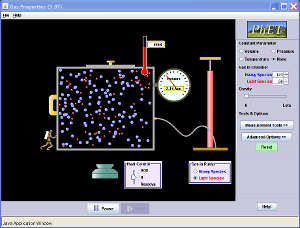
5.12 Recall that molecules in a gas have a random motion and that they exert a force and hence a pressure on the walls of the container
Why does the needle on the meter move when gas particles are introduced into the box?
My answer – The meter moves according to how many and much collisions occur against the wall of the box.
Official answer – The gas particles collide with all of the walls of the container. The wall on the right moves outwards and moves the needle.
What does the meter measure?
My answer – number and force of collisions of particles against the wall of the box
Official answer – Pressure, The gas particles colliding with the walls make a force on the walls. The walls have a surface area so the quantity measured is pressure, p = F/ A.
5.15 Understand that an increase in temperature results in an increase in the speed of gas molecules
1) How do the particles create a pressure?
Pressure is created by particles colliding with the walls of the container.
2) If you increase the temperature, how does the movement of the particles change?
If you increase the temperature, the average speed of the particles increases.
3) If you increase the temperature, how does the number of collisions per second change?
If you increase the temperature, the number of collisions per second increases.
4) If you increase the temperature, what does this do to the pressure?
If you increase the temperature, the pressure increases because more collisions (i.e. greater force) occur with the same area.

5.11 Understand the significance of Brownian Motion
Brownian motion: to show that molecules of air hitting the smoke particles (silver), causing a random motion, are moving with a random motion themselves. e.g. smoke particles being “bombarded” by air.
The view on the left shows what we see under the microscope.
The red particles are too small to see even under a microscope!
1) Draw the path of a smoke particle in air (3 marks)
It vibrates and moves around the area in random directions.
(random length, 
2) Explain what is meant by Brownian Motion of smoke particles in air and how it provides evidence for air particles. (4 marks)
- We can see the large smoke particles.
- We can’t see the much smaller air particles.
- But the smoke particles move when the air particles collide with them.
- So the movement of the smoke particles is evidence for the existence of air particles.
3) What change would you expect to see in the movement of the smoke particles if the air was cooled down? Why? (2 marks)
- The smoke particles would move slower.
- Because the air particles are moving slower and hitting them with less force.


1) Draw the path of a smoke particle in air (3 marks)
It vibrates and moves around the area in random directions. (See the attachment)