Wednesday, 29 February 2012

7.10 to 7.12 questions

7.10 to 7.12 questions

01 February 2012

09:46
1. What happens to the amount of ‘mother’ nuclei as time passes?
2. What sort of radioisotope will decay the fastest - one with a long half life or one with a short half life?
3. Does half life tell us exactly when a particular nucleus in a radioisotope will decay?
4. What are the two definitions of half life?
5. What does the activity of a source mean?
6. What is the unit of activity?
7. What will happen to the number of ‘mother’ nuclei after two half lives?
8. What will happen to the activity of a source after two half lives?

7.10 to 7.12 calculation questions

12 January 2012

10:24
1. A radioisotope has a half life of 12 years. What fraction of the radioisotope will be left after 60 years?
2. If the activity of a sample falls to 1/64th of its original level after 2 hours, what is the half life of the sample?
3. The background radiation in a laboratory is 7 Bq. The count rate from a radioisotope is measured and it has a reading of 119 Bq. If the half life of the radioisotope is 10 minutes, what will be the reading 20 minutes later?
4. Potassium decays into argon. The half life of potassium is 1.3 billion years. A sample of rock from Mars is found to contain three argon atoms for every atom of potassium. How old is the rock?

7.10 to 7.12

7.10 to 7.12 starter

02 February 2012

10:30
· Smoke detectors use 241Am to emit alpha particles which pass through a small air gap before being detected. If smoke particles are present they interrupt the beam of alpha particles and this triggers the alarm to go off
· Tomorrow, will the 241Am still be as radioactive?
· Next year, will the 241Am still be as radioactive?
· In a thousand years, will the 241Am still be as radioactive?

Answers
· To answer the questions, we need to know the half life of Americium-241 which is 432 years
· Tomorrow and even next year its activity will hardly have changed at all (sensible for a smoke detector - you don't want it to suddenly stop working!)
· In a thousand years its activity will have dropped to about a quarter

7.10 to 7.12

12 January 2012

10:24
· 7.10 understand that the activity of a radioactive source decreases over a period of time and is measured in becquerels
· 7.11 recall the term ‘half-life’ and understand that it is different for different radioactive isotopes
· 7.12 use the concept of half-life to carry out simple calculations on activity

Half-life of Different Isotopes
· http://youtu.be/S-goxH05LbY
>
>
>

PhET animation - alpha decay

31 January 2012

13:34
>

Website

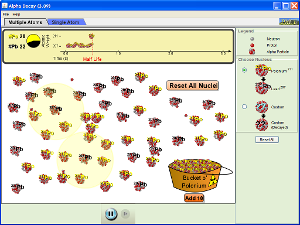
http://phet.colorado.edu/en/simulation/alpha-decay

Embed code for your blog

Alpha Decay

Click to Run

PhET animation - beta decay

31 January 2012

13:34
>

Website

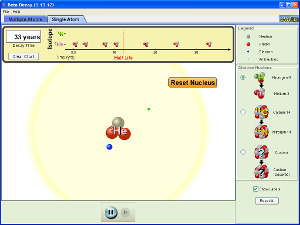
http://phet.colorado.edu/en/simulation/beta-decay

Embed code for your blog

Beta Decay

Click to Run

interactive simple half life calculations.swf Download this file

Half life.pptx Download this file

Decay of Balonium - exponential graph.swf Download this file

7.6 and 7.7

7.6 and 7.7

12 January 2012

10:24
· 7.6 describe the effects on the atomic and mass numbers of a nucleus of the emission of each of the three main types of radiation
· 7.7 understand how to complete balanced nuclear equations
>


>

Did you spot the deliberate mistake on this animation?


>

Answer

The symbol for Neptunium is Np not NP!
[cid:image001.png@01CCF6ED.F4112C70]

7.6 and 7.7 Plenary

12 January 2012

10:24
>
>

interactive alpha and beta decay eqns.swf Download this file

beta decay of C14 animation.swf Download this file

Balanced nuclear equations.pptx Download this file

Balanced nuclear equations plenary mulichoice question.pptx Download this file

alpha decay of Am241 animation.swf Download this file

Image001

Wednesday, 22 February 2012

7.4 to 7.9 plenaries

alpha, beta, gamma summary table.pptx Download this file

7.4 to 7.9 plenaries

01 February 2012

13:09

>


>

7.9

background radiation.pptx Download this file

7.9

12 January 2012

10:24
· 7.9 recall the sources of background radiation
>

Whys Guy
· http://youtu.be/CUqdLwIITWM

7.8

detection of radiation.pptx Download this file

7.8

12 January 2012

10:24
· 7.8 understand that ionising radiations can be detected using a photographic film or a Geiger-Muller detector
>

7.4 and 7.5

7.4 and 7.5 starter

01 February 2012

10:00

Tell the person next to you…
· What are the 7 parts of the electromagnetic spectrum you learnt in P3, Waves?
· What are they in order of increasing frequency?

>

(Note that microwaves are missing from this animation!)

Answers
· Radio waves
· Microwaves
3. Infra Red
4. Visible
5. Ultra violet
6. X-Rays
7. Gamma Rays

7.4 and 7.5

12 January 2012

10:24
· 7.4 understand that alpha and beta particles and gamma rays are ionising radiations emitted from unstable nuclei in a random process
· 7.5 describe the nature of alpha and beta particles and gamma rays and recall that they may be distinguished in terms of penetrating power

Producing Alpha, Beta and Gamma radiation
· http://youtu.be/pHUgL_RS9ng


>

>


Penetrating Power
· http://www.youtube.com/watch?v=48JQaZHuFsQ&feature=youtu.be
· http://youtu.be/61y2GTr0MlQ


>

>


>

>


Ionisation


>

>

>

Effect of magnetic and electric fields
>
>

producing a,b,g.pptx Download this file

penetrating power.swf Download this file

ionisation.pptx Download this file

Interactive simulation - penetration of radiation.swf Download this file

effect of magnetic field on a,b,g.swf Download this file

effect of electric field on a,b,g.swf Download this file

e-m spec.swf Download this file

DJFPh109ioniz2.swf Download this file

DJFPh109gammy5.swf Download this file

DJFPh107pene3.swf Download this file

decays emitting a,b,g.swf Download this file

Animation - ionisation of atom by radiation.swf Download this file

7.3

Isotopes.ppt Download this file

7.3

12 January 2012

10:24
· 7.3 understand the terms atomic (proton) number, mass (nucleon) number and isotope
>

PhET animation - build an atom

31 January 2012

13:34
>

Website

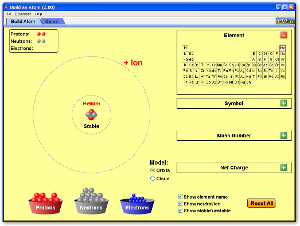
http://phet.colorado.edu/en/simulation/build-an-atom

Embed code for your blog

Build an Atom

Click to Run

PhET animation - isotopes

31 January 2012

13:34
>

Website

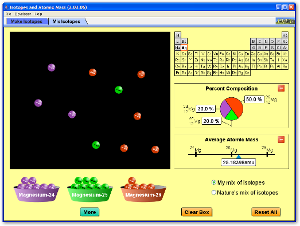
http://phet.colorado.edu/en/simulation/isotopes-and-atomic-mass

Embed code for your blog

Isotopes and Atomic Mass

Click to Run

7.2

7.2 starter

31 January 2012

11:35

Tell the person next to you…
· The names of 3 subatomic particles
· What properties do they have?
>
>

7.2

11 January 2012

14:49
· 7.2 describe the structure of an atom in terms of protons, neutrons and electrons and use symbols such as 146C to describe particular nuclei
>
>

sub-atomic particles - drag and drop.swf Download this file

Proton number and mass number.ppt Download this file

atomic structure of Li - mass and proton numbers.swf Download this file

atomic structure - electrons orbiting the nucleus.swf Download this file

Untitled

Thursday, 9 February 2012

6.19 and 6.20 Plenary answers

6.19 and 6.20 Plenary answers

01 December 2011

18:08
[cid:image001.png@01CCE7CB.95BA8CB0]
a. Vs/Vp=ns/np

Vs/2=80/20

Vs=8V


b. Vs/Vp=ns/np

Vs/10=20/100

Vs=2V


c. Vs/Vp=ns/np

Vs/240=20/400

Vs=12V


d. Vs/Vp=Ns/Np

Vs/4=2000/50

Vs=160V

[cid:image002.jpg@01CCE7CB.95BA8CB0]
2. Vs/Vp=ns/np

3/24=ns/480

ns=60turns

[cid:image003.jpg@01CCE7CB.95BA8CB0]
a. Iron (Why? Iron is a magnetically soft material - it can be magnetised and lose its magnetism easily. This is necessary in a transformer as the magnetic field needs to change repeatedly)
b. electrical energy in the primary coil => magnetic energy in the core =>electrical energy in the secondary coil
c. dc current produces a steady magnetic field in the core. To induce a current in the secondary coils there must be a changing magnetic field in the core.

[cid:image004.jpg@01CCE7CB.95BA8CB0]
a. Step down (because the voltage decreases)


b. Vs/Vp=ns/np

12/240=ns/1000

ns=50turns


c. P = V x I

24 = 12 x I

I = 2A


d. Power in secondary = 24W


e. Power in primary = 24W


f. P = V x I

24 = 240 x I

I = 0.1A


g. The current would be greater/double

Why?

Efficiency = Useful Pout/Total Pinx100

50 = 24/Total Pin x 100

Total Pin = 48W

P = V x I

48 = 240 x I

I = 0.2A

Plenary questions

6.18 Plenary Multichoice questions

01 December 2011

18:13

>

6d Plenary answers
[cid:image001.png@01CCE7CD.E0122820]
[cid:image002.png@01CCE7CD.E0122820]
[cid:image003.jpg@01CCE7CD.E0122820]
a.deflection to the left
b. deflection to the left
c. no deflection
1. push the magnet in quicker
2. use a coil with more turns
3. use a stronger magnet

P6 Plenary: 10 multi-choice questions

14 December 2011

12:49

>

P6 Multichoice questions.pptx Download this file

6d Plenary Multichoice questions.pptx Download this file

Thursday, 2 February 2012

6.18

National grid worksheet.doc Download this file

Thank you

SooHyun

SooHyun Lee
11P
Bangkok Patana School
________________________________________
From: Matt Baker
Sent: 03 February 2012 09:01
To: Andrew Koomenjoe Nyaga; Arisara Amrapala; Boondaree Chang; Chrischawit Chomsoonthorn; Christopher Lo; Connor Blair Sailes; Frazer Allen Briggs; Huei-Yu Daniel Lo; Isabel Catriona McDonald; Kavin Supatravanij; Luke Michael Gebbie; Lydia Anna Foley; Morrakot Sae-Huang; Puchawin Borirackujarean; Qing Tang; Sanyam Grewal; Sebastien Grimm; Soo Hyun Lee; Tatiksha Singh; Usa Wongsanguan; Yanida Areekul; Yi-Lin Huang
Subject: 6.18

6.18

01 December 2011

18:08
· 6.18 explain the use of step-up and step-down transformers in the large-scale generation and transmission of electrical energy
· http://youtu.be/LZKhGGBcYFI

6.20

6.20

01 December 2011

18:08
· 6.20 recall and use the relationship (for 100% efficiency):

input power = output power

Vp Ip = Vs Is
>

6.19 and 6.20 Plenary

01 December 2011

18:08
>
[cid:image001.png@01CCE252.4D9BE600]

transformer worksheet.doc Download this file

transformer animation with sliders and example calculations.swf Download this file

Image001

6.19

transformer quick quiz.swf Download this file

6.19

01 December 2011

18:08
· 6.19 recall and use the relationship between input (primary) and output (secondary) voltages and the turns ratio for a transformer:

input (primary) voltage = primary turns

output (secondary) voltage secondary turns

Vp/Vs = np/ns
>

6.17

Thank you

SooHyun

SooHyun Lee
11P
Bangkok Patana School
________________________________________
From: Matt Baker
Sent: 03 February 2012 09:00
To: Andrew Koomenjoe Nyaga; Arisara Amrapala; Boondaree Chang; Chrischawit Chomsoonthorn; Christopher Lo; Connor Blair Sailes; Frazer Allen Briggs; Huei-Yu Daniel Lo; Isabel Catriona McDonald; Kavin Supatravanij; Luke Michael Gebbie; Lydia Anna Foley; Morrakot Sae-Huang; Puchawin Borirackujarean; Qing Tang; Sanyam Grewal; Sebastien Grimm; Soo Hyun Lee; Tatiksha Singh; Usa Wongsanguan; Yanida Areekul; Yi-Lin Huang
Subject: 6.17

6.17

01 December 2011

18:08
· 6.17 recall the structure of a transformer, and understand that a transformer changes the size of an alternating voltage by having different numbers of turns on the input and output sides

6.17 Practical - model answers

17 January 2012

14:33
· If you…
· Turn the powerpack to dc

[cid:image001.jpg@01CCE252.359BA450]

No current is induced in the Secondary Coil. To induce current you need a changing magnetic field and this is not produced by applying dc to the Primary Coil
· Turn the powerpack to ac

[cid:image002.jpg@01CCE252.359BA450]

ac is induced in the Secondary Coil. To induce current you need a changing magnetic field and this is produced by applying ac to the Primary Coil
3. Increase the number of turns in the Secondary Coil

The size of the induced voltage in the secondary coils increases
4. Increase the voltage on the Primary Coil

[cid:image003.jpg@01CCE252.359BA450]

The size of the induced voltage in the secondary coils increases
5. Decrease the number of turns in the Secondary Coil

The size of the induced voltage in the secondary coils decreases
6. Decrease the voltage on the Primary Coil

The size of the induced voltage in the secondary coils decreases